II. Predation, reproductive traits, and behavior
III. The evolution of reproductive traits
Research Program
My Ph.D. work under the supervision of Dr. Molly Cummings at UT Austin sought to determine how fundamental axes of behavior and cognition vary among species with different mating systems and populations facing different levels of predation. The first two studies I conducted (see here and here) focused on potential behavioral and cognitive strategies that females might develop in response to male mating tactics. I conducted behavioral and cognitive assays on several species of live-bearing fish (family: Poeciliidae) to answer these questions. I found variation in behavioral and cognitive strategies among females from different mating systems, but that these patterns were highly dependent on species pair and ecology. In conducting this work, I found myself (somewhat existentially!) inverting the question from 'what are the consequences of these different mating systems?' to 'why do these different mating systems exist in the first place?'
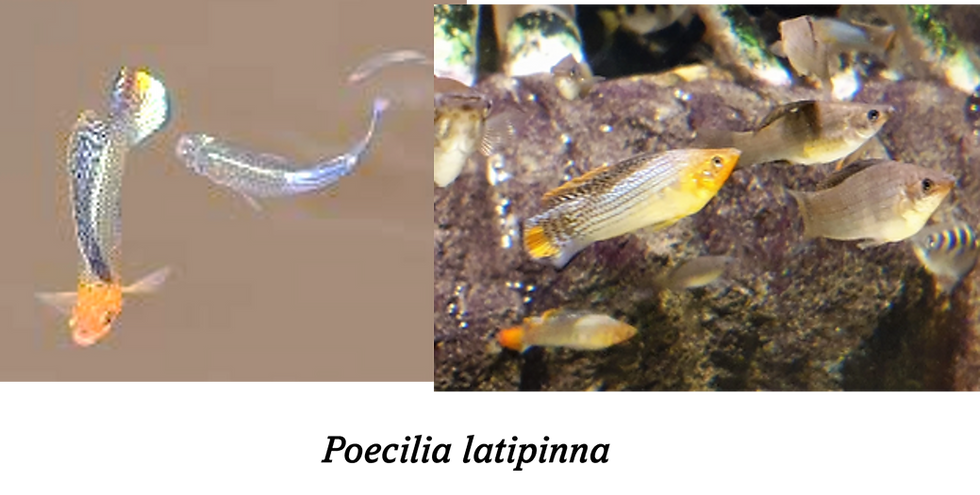
The final study of my Ph.D. (currently in review) aims to assess whether behavioral responses to predation environments are shared or unique between two common poeciliid fish species that co-occur in Texas: Gambusia affinis and Poecilia latipinna. These species have strikingly different reproductive traits and also differ in size and foraging ecology, which may affect how they respond to predation risk. The study involved a lot of fieldwork in Texas, determining relative predation levels between sites and attempting to replicate comparisons across waterways.
Through this experience in the field, I became interested in the natural history of predator-prey interactions and in developing methods that accurately capture the context and intensity of predation in nature. Predation is a factor that is commonly invoked as a potential constraint on sexual selection, but many questions still remain about its impact on reproductive traits.
My research as a postdoc with Dr. Daniel Powell at LSU, will focus on the evolutionary causes of reproductive and signaling traits in animals. Why do some animals invest so much into pre-mating displays, ornaments, and size, while others remain comparatively diminutive? Conversely, why do some organisms invest comparatively little into pre-mating traits and more into peri-mating (i.e. copulatory) and post-mating traits? Are there ecological conditions, such as predation, seasonality, or resource availability, that favor evolutionary transitions in a particular direction?
To begin answering these questions, I will continue working with the family Poeciliidae, combining macroevolutionary comparative work across large numbers of species with more granular field and behavioral experiments.
I. Mating tactics, behavior, and cognition

Syntopic species pairs used in the 2nd study of my Ph.D. (Inman et al. 2025. Biological Journal of the Linnean Society)
II. Predation, reproductive traits, and behavior

I. Mating tactics, behavior, and cognition
P. latipinna and G. affinis make for an interesting comparative contrast: they are often syntopic where their ranges overlap, but vary markedly in morphology and mating tactics.
III. The evolution of reproductive and signaling traits

Poeciliid sister species that differ dramatically in male size and ornamentation. Taxa on the left have lost ornamentation over evolutionary time, while taxa on the right have retained it. The ultimate causes behind such losses are still unclear.
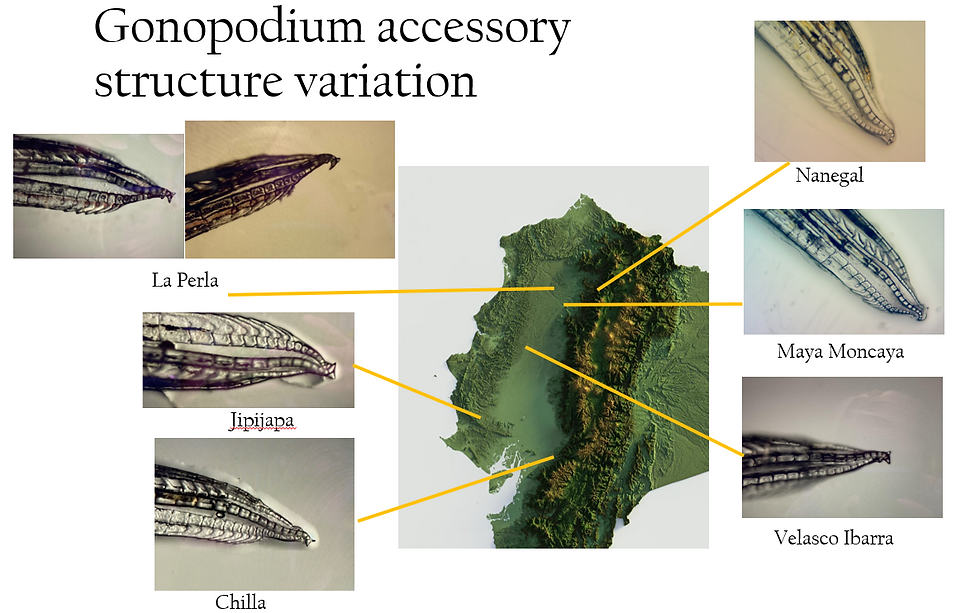

Variation in a (potential) signaling trait (L) and in a reproductive trait (R) in populations of the Ecuadorian poeciliid Pseudopoecilia fria. Ps. fria exhibits subtle intra- and inter-population variation in a number of traits across a sizable geographic range. Work with collaborators at Universidad de Las Americas, Quito on this species is still in its infancy.